The Feelings Wheel
Naming a feeling precisely is the first step to understanding it. This free interactive wheel takes you from seven core emotions to 82 precise ones — click any segment to read what it means and when it tends to show up.
How to use the feelings wheel
- Start in the centre. Ask yourself which of the seven core families is closest to what you feel right now — happy, sad, disgusted, angry, fearful, bad or surprised.
- Move outwards. Each ring makes the feeling more precise: from angry to frustrated, from frustrated to annoyed or infuriated. Stop at the word that fits best.
- Use the word. Write it down, say it out loud, or tag it on a journal entry. Research on affect labelling suggests that putting feelings into words can help take the edge off them.
All 82 emotions, family by family
Every emotion on the wheel, with a short plain-language description. The chips under each entry are the outer-ring feelings that make it more precise — the words you land on when you keep narrowing down.
Happy
Happy is the family of feelings that open you up: energy, warmth, connection and ease. Happiness is rarely one thing — the wheel splits it into nine distinct flavours, from playful to optimistic, because “good” on its own hides more than it reveals.
Playful
Light, mischievous energy — you want to joke, tease and play rather than be serious.
Aroused Cheeky
Content
Quietly satisfied with things as they are; nothing missing, nothing urgent.
Free Joyful
Interested
Your attention is caught and you want to know more.
Curious Inquisitive
Proud
You did something well and you know it — achievement felt from the inside.
Successful Confident
Accepted
You feel welcome and taken as you are, without having to perform.
Respected Valued
Powerful
Capable and in charge of your own life; you trust your own strength.
Courageous Creative
Peaceful
Calm, warm stillness — often felt with people or places you love.
Loving Thankful
Trusting
Safe enough to open up and let someone closer.
Sensitive Intimate
Optimistic
The future looks workable — you expect things to go well.
Hopeful Inspired
Sad
Sad feelings pull inwards — loss, loneliness, heaviness, hurt. They are usually a sign that something mattered. Naming which kind of sadness you feel is often the difference between sitting in fog and knowing what you are actually grieving.
Lonely
Cut off from others, whether or not anyone is actually around.
Isolated Abandoned
Vulnerable
Exposed and easily wounded; your defences are down.
Victimised Fragile
Despair
Hope has drained away and everything feels too heavy to change.
Grief Powerless
Guilty
You believe you did something wrong and it keeps pressing on you.
Ashamed Remorseful
Depressed
Flat, empty heaviness that drains meaning from things you usually care about.
Empty Inferior
Hurt
Someone or something got through to a tender spot — pain with a direction.
Disappointed Embarrassed
Disgusted
Disgust is the feeling of wanting distance from something — a situation, a behaviour, sometimes yourself. It ranges from mild disapproval to being appalled, and it often hides underneath judgements that feel purely rational.
Repelled
A strong urge to pull away from something that feels wrong or unsafe.
Horrified Hesitant
Awful
Sickened by something — it feels genuinely dreadful to be near.
Detestable Nauseated
Disappointed
Something or someone fell short of what you expected, and it lingers.
Revolted Appalled
Disapproving
You look at it and think: this is not how it should be.
Judgmental Embarrassed
Angry
Anger is energy against something that feels wrong or unfair. It is rarely just rage: the wheel distinguishes eight kinds, from feeling distant or critical to feeling humiliated or let down — each pointing at a different unmet need.
Critical
Fault-finding mode — your attention keeps landing on what is wrong.
Dismissive Sceptical
Distant
Withdrawn and switched off from people; anger gone cold.
Numb Withdrawn
Frustrated
Blocked — you keep trying and something keeps getting in the way.
Annoyed Infuriated
Aggressive
Anger pushing outwards, looking for confrontation.
Hostile Provoked
Mad
Hot, loud anger that wants to be expressed right now.
Jealous Furious
Bitter
Old anger that turned inward and soured; resentment with a history.
Violated Indignant
Humiliated
Made small in front of others — anger fused with shame.
Ridiculed Disrespected
Let down
Someone you counted on did not come through.
Disrespected Betrayed
Fearful
Fear is the alarm system: something feels threatened — your safety, your standing, your sense of being enough. Anxiety, insecurity and feeling weak all live here, and each asks for a different kind of reassurance.
Scared
Immediate fear with a clear object — something out there feels dangerous.
Helpless Frightened
Anxious
Restless, forward-looking worry without one clear cause.
Overwhelmed Worried
Insecure
Unsure of your own worth and expecting to be found lacking.
Inadequate Inferior
Weak
Out of strength — you feel unable to carry what is being asked of you.
Worthless Insignificant
Rejected
Left out or turned away by people you wanted to belong with.
Excluded Persecuted
Threatened
On guard — something feels like it could harm you or what is yours.
Nervous Exposed
Bad
The “bad” family covers the grey, drained states that are not quite sadness or fear: bored, busy, stressed, tired. They are easy to dismiss and easy to confuse — yet stress and tiredness often have something else sitting underneath them.
Bored
Understimulated and restless; time drags and nothing pulls you.
Indifferent Apathetic
Busy
Too much at once — rushed, scattered and pressed for time.
Pressured Rushed
Stressed
Carrying more load than you have capacity for, and feeling it.
Overwhelmed Out of control
Tired
Depleted in body or mind; rest is the actual need.
Sleepy Unfocused
Surprised
Surprise is the shortest-lived emotion — the jolt when reality does not match expectation. It can tip either way: into excitement and amazement, or into confusion and dismay. The wheel keeps both directions.
Startled
The jolt itself — caught off guard for a moment.
Shocked Dismayed
Confused
Things stopped adding up and you have lost the thread.
Disillusioned Perplexed
Amazed
Struck by something bigger or stranger than expected — in a good way.
Astonished Awe
Excited
High, happy energy pointed at something coming.
Eager Energetic
The same wheel, inside the app
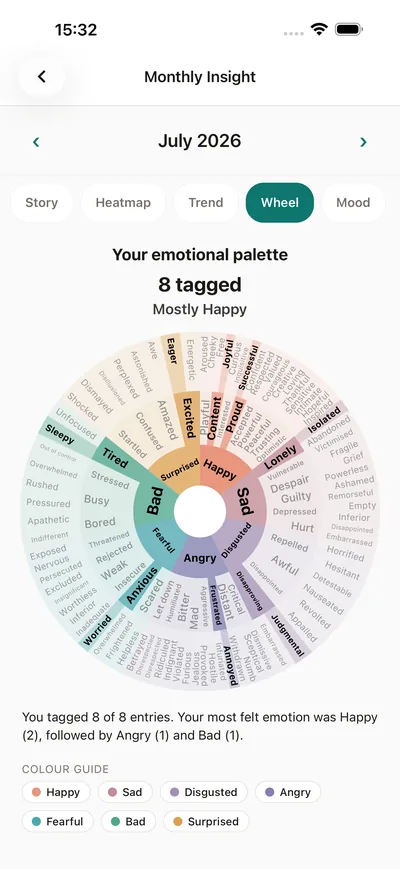
This page’s wheel is lifted straight from BrightLog’s journal: on a mood check-in you can tag several feelings at once — the ones that fit how the day went — and on a journal entry you name the one that fits best. The insights then draw your own emotional palette from your entries, and the Mood view shows which feelings kept coming up on your check-ins.
Questions about the feelings wheel
What is a feelings wheel?
A feelings wheel is a circular map of emotions: a few broad families in the centre, more precise words as you move outwards. It solves a real problem — most of us default to “fine”, “stressed” or “bad”, and those words are too blunt to act on. The wheel turns “bad” into something workable, like “let down” or “overwhelmed”.
Why 7 core emotions and 82 in total?
This wheel uses the widely shared three-ring layout: seven families — happy, sad, disgusted, angry, fearful, bad and surprised — split into 41 sub-emotions and 82 outer-ring feelings. It is the exact version built into the BrightLog journal, so any feeling you find here can be tagged on a real entry and tracked over time.
Does naming emotions actually help?
Putting a feeling into words — researchers call it affect labelling — appears in studies to lower the intensity of the emotional response a little, like turning the volume down a notch. It is also the starting move of cognitive behavioural techniques: you can only question a feeling you have named. The wheel makes the naming part easier.

Tag these emotions on real days
BrightLog is a private journal with this exact wheel built in — log a mood in seconds, tag the precise feeling and watch your patterns emerge. No account needed: your information never leaves your device, and a backup, only if you choose one, goes to your own iCloud or Google Drive.