Why habits collapse
Take the classic: “I should stretch every morning.” Week one goes fine. Then one rushed Tuesday you skip it, the chain is broken, the guilt makes the habit unpleasant to even think about, and three weeks later “I should stretch” has become a small recurring self-accusation rather than a plan.
Look at what that habit was built on: a vague trigger (“morning”), an undefined size (five minutes? twenty?), an all-or-nothing streak, and no record of the times it did happen. Every one of those is a known failure point, and every one is fixable by design — not by wanting it more. The research on behaviour change keeps landing on the same, slightly deflating conclusion: reliable habits are built from specific cues, small actions and forgiving tracking, not from motivation, which is precisely the ingredient that varies day to day.
Make it too small to fail
The single most effective change is shrinking the habit until the worst version of your day can still absorb it. Not “stretch for ten minutes” — “one forward fold while the coffee brews.” Thirty seconds. The point of the tiny version is not that thirty seconds transforms your body; it’s that it keeps the habit alive, and a live habit grows on the good days by itself. A dead one grows on none.
The test: if you can honestly say “I could do this with flu, on a deadline, after a terrible night” — it’s the right size. If not, cut it in half and test again. You can always do more; the commitment stays tiny.
Give it an anchor: the when-then plan
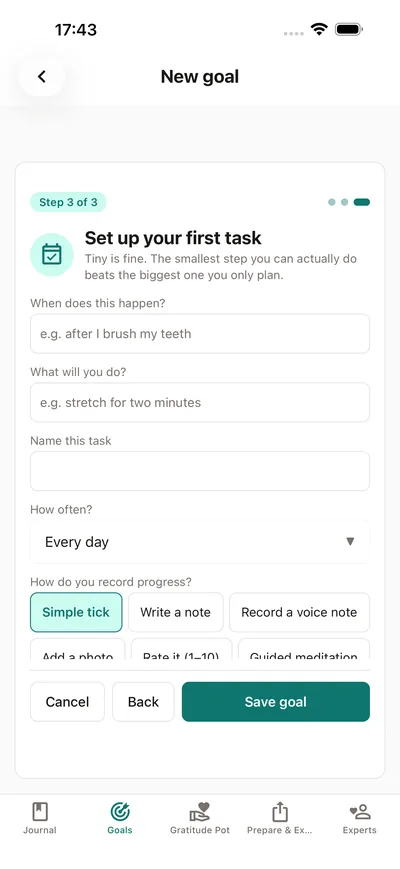
“Every morning” is not a cue — nothing in your morning taps you on the shoulder. A when-then plan (researchers call them implementation intentions) attaches the habit to something that already reliably happens: “When I put the kettle on, then I do my forward fold.” “When I close the laptop for lunch, then I walk one lap outside.”
This is one of the best-supported findings in behaviour-change research: a large body of studies shows that people who form a specific when-then plan follow through substantially more often than people with the same goal and no plan. The mechanism is mundane and wonderful: the decision gets made once, in advance, instead of being renegotiated every morning with whoever you are at 7 a.m.
Track it — and protect the streak
Ticking a habit off works — the record is satisfying, and the growing chain becomes its own reason not to stop. But the classic “don’t break the chain” has a design flaw: the chain’s motivating power is exactly what makes one missed day catastrophic. Miss once and the thing you built for encouragement flips into evidence against you — that’s the moment many people give up tracking altogether.
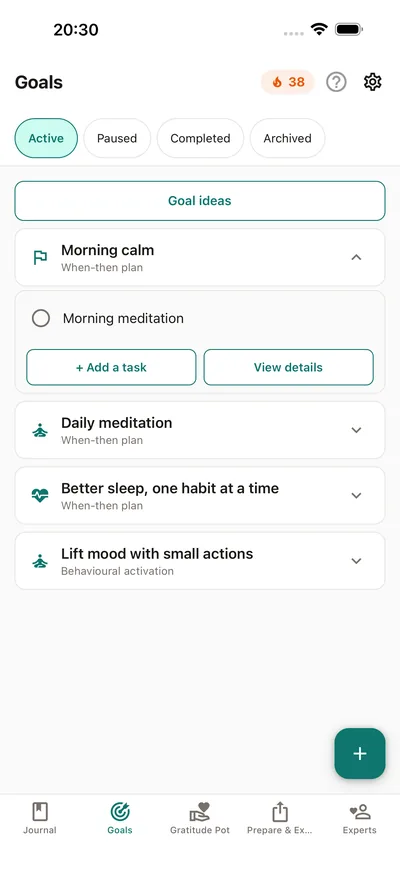
Two rules fix it. First, judge the week, not the day: a habit hit 5 times out of 7 is a thriving habit, not a 71% failure — which is why BrightLog scores each goal against its own plan for the week, “3 of 4 this week”, with a ring that fills as you go and never a red day. Second, use tools that can forgive: the daily streak carries one automatic streak freeze a month, so a single bad day spends the freeze instead of zeroing months of history; a streak you have seen never shrinks; and when three due days pass untouched, the app asks whether you’d rather adjust the goal’s rhythm than abandon it. A tracker’s job is to keep you in the game, not to prosecute you.
And because a plan you can see is a plan you keep, BrightLog’s home-screen widgets put today’s task list — and the streak it feeds — right on your home screen.
Twelve starter goals that survive real weeks
Each of these is deliberately tiny, has a natural anchor, and maps onto a realistic rhythm (the rhythms in brackets are ones BrightLog offers — every day, weekdays, weekends, weekly, any few days a week you like, fortnightly, monthly, yearly, just once, or a custom pattern):
- One forward fold while the kettle boils (every day) — the famous morning stretch, at survivable size.
- Three sentences in the journal after brushing teeth (every day) — see how to start journaling.
- One thing that was better than it had to be (every day, evenings) — gratitude, the honest version.
- Ten slow breaths before opening email (weekdays) — a micro-meditation; here’s how to grow it.
- Walk one lap outside after lunch (any 3 days a week — you pick which as the week goes).
- Phone out of the bedroom (every day — tick it when the charger stays in the kitchen).
- One glass of water before coffee (every day).
- Call or message one friend (weekly — connection is a habit too).
- A proper lie-in without guilt (weekends — rest counts as a goal).
- Review the month’s mood chart (monthly — pairs with mood tracking).
- Tidy one drawer (fortnightly — small, visible, weirdly satisfying).
- A 10-minute guided wind-down before bed (custom: Sunday, Tuesday and Thursday — realistic beats nightly).
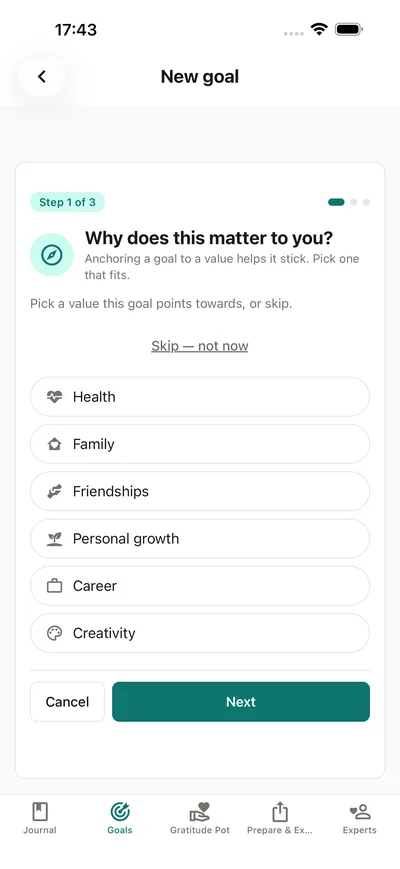
Or start from the app’s own list: ten Goal ideas — nine evidence-based starting points such as better sleep, small mood-lifting actions, reshaping thoughts and stepping towards what scares you, plus Take my medication, a daily reminder at a time you choose. If none of these fit either, start from the other end: BrightLog’s goal wizard opens by asking why a goal matters — health, family, friendships, personal growth, career, creativity, wellbeing, helping others — and a goal anchored to a value you actually hold survives longer than a resolution copied from a list. Ours included.
The morning stretch, rebuilt
Put the pieces together on the habit this article opened with:
- Size: one forward fold, about thirty seconds. More is welcome, never owed.
- Anchor: “When I put the kettle on, then I fold.” The kettle is the reminder — no alarm needed, though a gentle scheduled nudge helps the first two weeks.
- Tracking: a simple tick, judged weekly. Five ticks a week is a win.
- Failure plan: a missed day costs the month’s streak freeze, not the streak, and a day that was genuinely too hard is one tap (Too hard today) rather than a silent gap. Any words about what got in the way stay in the goal’s Notes, to read again, add to or change later. Two missed weeks means the habit is the wrong size or the anchor is wrong — shrink or move it, don’t blame yourself.
That’s the whole method. It is unglamorous on purpose: the glamorous version is the one you already tried.
Judge the week, not the day: Your week
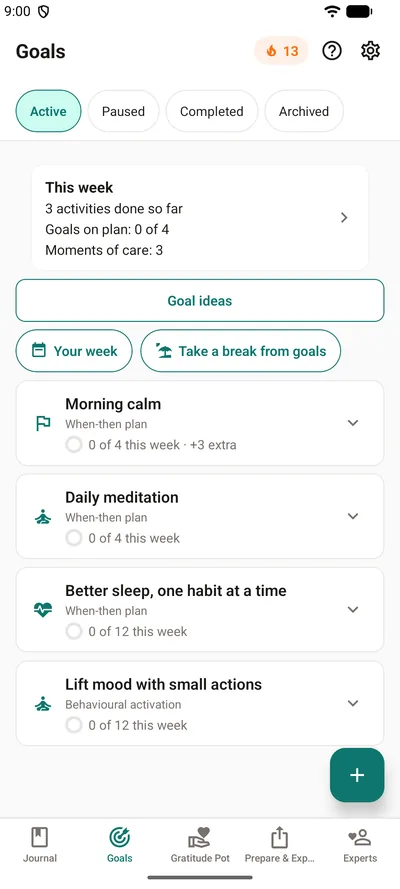
The first rule above is now a screen. This week, at the top of your goals, keeps a count that can only go up — activities done, goals on plan, moments of care — and speaks only when it has good news: “3 more than your usual week”, or “Your best week since…”. A lower week says nothing at all.
Tap it for Your week: a ring per goal against that goal’s own plan, “+2 extra” for the days you did more, “4 weeks in a row” once a run builds (a week with nothing due neither counts nor breaks it), seven dots for the days and twelve weeks of tiles behind them — never a red one. Below that, what the week noticed: the task your mood ran higher on the days you did it, what got in the way, the milestones you reached. Then Next week, one line per task — Keep, Adjust or Pause — so the review ends in a plan rather than a verdict. Around the turn of the week a small card, Your week in review, brings the same look-back to the goals list; an optional end-of-week reminder can too; and the whole thing exports as a PDF or copies as text. Seeing someone? Use this in your therapy preparation turns this week, the last two weeks or the last month into a session summary that includes your goals and habits.
Two more things keep the week honest. Tick a Rate it task and BrightLog asks how it felt — how enjoyable, how much of an achievement, or a question of your own — and after a handful of ratings the goal shows What lifts you: the activities that actually score highest, so next week is built from your own evidence rather than a guess. And Take a break from goals — a day, three days, a week, or until a date you choose — silences every goal reminder and counts nothing as missed, because rest is a plan too.
And when a goal is done, it gets its moment. Small wins keep motivation alive, so finishing a goal is celebrated: the mascot cheers, then a Goal complete! card shows the goal, the weeks it took and your check-ins. Share this turns it into a picture for a friend or your story — three styles to choose from, and the goal’s name stays hidden unless you switch it on.
What a goals tool should actually do
A checkbox on its own does not build a habit. The reason BrightLog’s goals live inside the journal is that every piece of the method above is built in: goals are planned with a when-then field (or, if you like more structure, a method such as behavioural activation) and an if-then plan for the days something gets in the way; each task gets its own rhythm — nine cadences, any few days a week included, plus fully custom patterns; and progress can be a simple tick, a note, a photo, a voice note, a 1–10 rating — or a guided meditation session, timer and gentle prompts included. The daily streak comes with a monthly freeze and never shrinks, breaks are built in, reminders are optional and per-task (a tick silences today’s), and it all sits next to your mood history, so you can actually see whether the walking habit and the better weeks arrive together. Add the daily nudges — small moments of care that count on the same This week strip — and the whole method is in one private place: on your device.