Why journals die in week two
The classic failure mode is starting like a novelist: a fresh notebook, a promise to write every evening, a page a day. That plan depends on the best version of you showing up daily — and journaling’s whole value arrives precisely on the days when that version doesn’t. So the streak breaks on the first exhausted Tuesday, the broken streak feels like failure, and the journal quietly becomes a coaster.
The fix is not more discipline. It is a smaller promise: one so small that the exhausted Tuesday version of you can still keep it.
Day one: write three sentences
Skip the introduction. You do not need to explain to your journal who you are. Tonight, write exactly three sentences:
- What happened — one concrete thing from today, however small. “Lunch outside with Sam.” “The meeting overran again.”
- What you felt — one named feeling. Not “fine”: a real word. If nothing comes, a feelings wheel exists for exactly this moment — start at one of seven families and narrow until a word fits.
- What it was about — your best one-line guess at why. It’s allowed to be wrong.
That is a complete journal entry. Anyone who tells you otherwise is selling notebooks.
The two-minute rule
Give journaling a fixed, tiny time box: two minutes, attached to something you already do every day — after brushing your teeth, on the train, with the first coffee. Habits attach far better to existing routines than to clock times, and two minutes is short enough that “I don’t have time” is never true.
Some days two minutes will turn into ten because you have things to say. Let it. But the promise stays two minutes, because the promise is what survives the bad weeks. Writing more than the minimum is a bonus, never the standard.
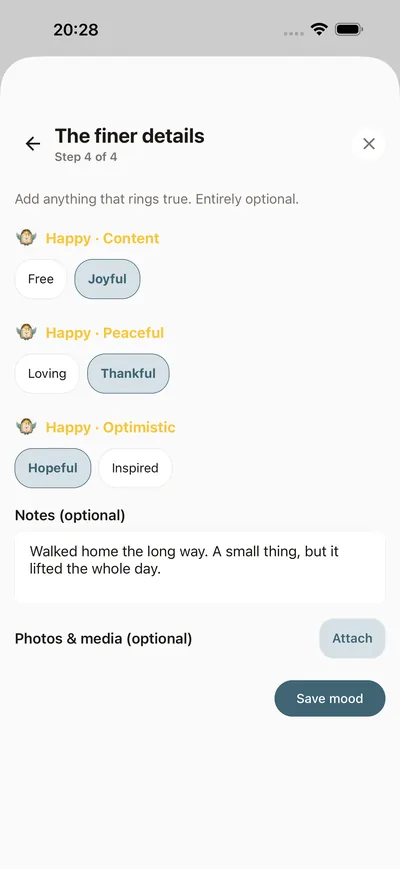
Two small things make the tiny promise easier to keep. Give it a cue you already have — BrightLog’s daily nudges include a Check in that opens the mood check-in with one tap — and never lose what you started: a half-written entry waits for you as a private draft.
What to write when you have nothing to say
“Nothing happened today” days are where most guides wave vaguely at inspiration. Concretely, three prompts that reliably produce something worth having:
- The residue prompt: what is still on your mind from today, even slightly? The thing that surfaces is rarely nothing.
- The body prompt: where in your body do you notice tension or ease right now? Shoulders, jaw, stomach — write one line about it. Feelings often show up physically before they show up in words.
- The gratitude prompt: one specific thing that was better than it had to be today. Specific beats grand — “the bus was on time” counts. (There is a whole practice built on this; see gratitude journaling.)
And sometimes the honest entry is: “Tired. Nothing to say.” Written down, even that is a data point — a run of those entries is worth knowing about.
Missed days are part of the plan
You will miss days. Plan for it now, and the miss loses its power to end the habit:
- Never write about the gap. No catch-up entries, no apologies to the journal. Start with today as if nothing happened.
- Use the two-day rule: missing one day is life; missing two in a row is the signal to do the three-sentence minimum tonight, however flat it feels.
- Shrink, don’t push. If entries are starting to feel like homework, the minimum is too big. Cut it — a mood and one line is enough to keep the thread alive.
- Let the app forgive you too. BrightLog’s daily streak spends one freeze a month on a single missed day, and a streak you have seen never shrinks; when one does end, a calm card keeps your best run and starts day one of the next.
Paper or app? An honest answer
Paper is wonderful for slow, long-form reflection: no notifications, a physical ritual, and handwriting genuinely slows thinking down in a useful way. If your journaling is twenty contemplative minutes with tea, buy the notebook — you do not need an app.
An app earns its place on three counts: it is with you in the queue and on the train (where many three-sentence entries get written), it can hold photos, video, a voice note or a document alongside the words — a photo even brings along the place it was taken — and it can show you patterns — a month of moods on one screen, which paper cannot do without a spreadsheet and a free evening. One caution in either direction: a journal is only honest if it is private. On paper that means a drawer you trust; in an app it means checking where entries are actually stored and who can read them — that question comes first in our guide to choosing a mood journal app.
What to expect after a month
Be suspicious of promises that journaling will transform you in thirty days. What a month of three-sentence entries realistically gives you:
- A vocabulary. Naming feelings gets faster and more precise with practice — and research on affect labelling suggests the naming itself takes some heat out of the feeling.
- A pattern or two you didn’t know about. The Sunday-evening dip. The way a certain meeting shows up in your entries every single week. Patterns are where journaling stops being a diary and starts being useful — that’s the case for adding a one-tap daily mood check-in alongside your entries (see how mood tracking works).
- A record that days were full. A month from now, “nothing happened” week will turn out to have contained things worth remembering. That alone quietly argues against the feeling that time is slipping past unrecorded.
Journaling is a practice, not a cure — for persistent low mood or anxiety, it sits alongside proper support, not instead of it. But as a daily two-minute habit, it is one of the cheapest, most portable self-knowledge tools there is.