Why small moments beat the grand plan
Small moments beat the grand plan because they fit the days you most need looking after — and a reminder to have one only helps if it stays quiet. In BrightLog you choose how many nudges arrive a day, from one to twelve (five to start with), and the hours they arrive in, 08:30 to 21:00 unless you change them. Any nudge can be answered with Later (it comes back in half an hour) or Not today (that kind stays quiet until tomorrow), the day turns gentler after a low mood, and the whole thing switches off under Settings → Notifications → Daily nudges. Unwanted notifications are what turn a kind reminder into a nag, so that is where this guide starts.
Self-care has a marketing problem: it is sold as a Sunday — a long bath, a run, a journal page, a phone switched off. The trouble is that the days you most need looking after are the days none of that fits. So the plan slips, the slipping feels like one more failure, and “take care of yourself” becomes a thing you feel guilty about rather than something you do.
The research points somewhere less glamorous and more useful. The things that reliably nudge mood are small and repeatable. Mild dehydration measurably dents mood and concentration, so a glass of water is not nothing. A five-minute walk every half hour lifted mood and cut fatigue in people sitting through a working day. Five minutes of slow breathing a day improved mood in a controlled trial. Every extra hour of daylight spent outdoors is linked to lower odds of depressive symptoms. Sending a short message to a friend is appreciated far more than the sender expects. Small acts of kindness give a modest, reliable lift. And practising self-compassion — talking to yourself as you would to a friend — lowered anxious and low mood across a meta-analysis of trials. None of these takes ten minutes. Most take one.
The honest caveat, stated plainly: these are supports, not treatments. Each effect is real and modest, and they add up because they are cheap enough to repeat. That is the whole argument for small moments — not that any one of them changes your life, but that you can actually have five of them on a Tuesday.
What a reminder has to get right
A self-care reminder has to get six things right: it must be few, not constant; timed to your day; varied enough that nothing repeats for weeks; kind without being cloying; easy to say no to; and quieter on hard days. Miss any one of them and the reminder becomes a nag. The reasons are consistent enough to write down as rules — here are the six, each with the reason behind it:
- Few, not constant. Prompts lose their effect as people get used to them — the studies that measured it saw the response fade day by day — and a handful of clustered moments beats an all-day drizzle of alerts. Five a day is plenty; twelve is the ceiling.
- Timed to your day. A “get some daylight” prompt at 9 p.m. is noise. Water and food belong to the daytime, movement to when you are sitting, rest to the evening — and everything belongs inside the hours you are actually awake.
- Varied. The same sentence at the same time stops being read by day four. A reminder needs a large enough vocabulary that nothing repeats for weeks.
- Kind, without being cloying. No “you forgot”, no “don’t break the chain”, no cheerleading, no diet talk. The tone that works is the one a good friend uses: an invitation, not an instruction.
- Easy to say no to. “Later” and “not today” must be one tap and cost nothing. A reminder that punishes a no has become a nag, and nags get muted for good.
- Quieter on hard days. The day you log a terrible mood is not the day to be told to tidy a drawer. A reminder that reads the room earns the right to speak on the other days.
Hold any reminder up against those six and you will know within a day whether it is worth keeping.
Twenty small moments of care
Twenty small moments of care cover the body, the mind, other people and the day: a glass of water, something to eat, a little movement, some daylight, a body check-in, looking after yourself, rest; a slow breath, noticing one thing, a screen break, learning something, something you enjoy, a mood check-in; reaching out, being kind to someone, being kind to yourself; a tiny tidy, one small step, a good thing, and a kind word. Each is small enough to do between two other things, and each has a reason behind it. They are also, not by accident, the twenty kinds of nudge BrightLog sends, under the names the app uses:






- For the body: Have some water (tea counts), Eat something (a snack counts — no calories, no “healthy”), Move a little (even around the room), Get some daylight (before four in the afternoon; opening a window counts), Body check-in (shoulders, jaw, posture), Look after your body (teeth, a shower, clean clothes) and Rest (afternoons and evenings only — a wind-down, never a wake-up).
- For the mind: Breathe (a long slow exhale, and the nudge opens a breathing timer), Take notice (one colour, one sound, the light in the room), Screen break, Learn something, Something you enjoy (a song, a hobby, a comedy) and Check in — a mood logged in one tap.
- For each other: Reach out (reply to one message), Be kind to someone, and Be kind to yourself — the one people skip and the one with the strongest evidence behind it.
- For the day: A tiny tidy (pull up the duvet, clear one surface — small, visible, oddly satisfying), One small step (towards a goal you already set), A good thing (an evening gratitude note, at most once a day) and A kind word — a short line of encouragement with no task attached at all.
How daily nudges work in BrightLog
Daily nudges in BrightLog work like this: from the moment you allow notifications, a handful of short reminders a day — five unless you change it, up to twelve — arrive spread across the hours you set, each a line written by hand in each of the app’s 20 languages, never generated, each with Done, Later and Not today underneath. Every Done counts as a moment of care and nothing more; it never touches your streak, your badges or your goals. On a day you log a low mood, the rest of the day’s nudges turn gentle. They were built against the six rules above, and everything about them is yours to set under Settings → Notifications → Daily nudges:
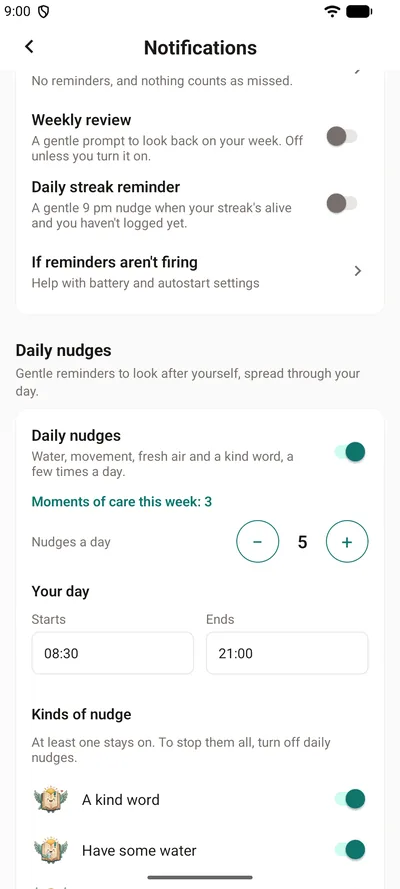
- Nudges a day — from one to twelve; five to start with.
- Your day — the hours you want them in, half past eight in the morning to nine at night unless you say otherwise. Nudges are spread evenly across it, each one shifted by a few minutes so the rhythm never feels mechanical, and never within three quarters of an hour of another BrightLog reminder.
- Kinds of nudge — a switch for each of the twenty kinds. A kind word opens each day, water comes round at least once, and the rest take turns — at the usual five a day, no line comes back within two weeks.
- Mute today for a day that needs quiet, or Pause for a day, three days or a week. Nothing is lost, nothing is counted against you, and a Preview button shows you the next nudge whenever you like.
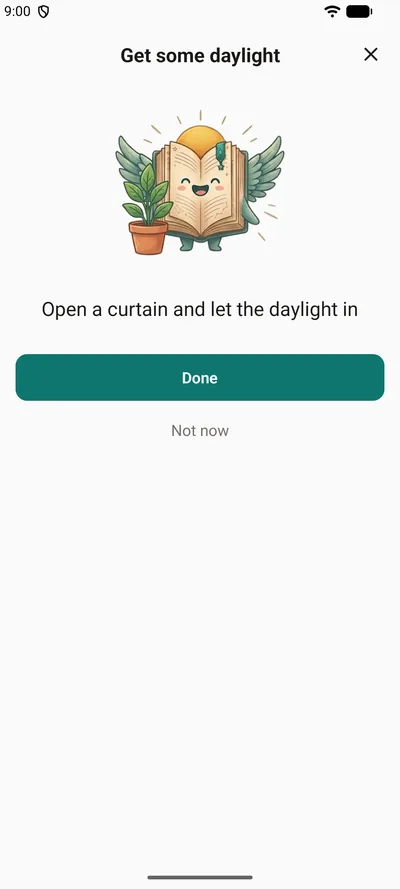
Each nudge arrives with three buttons: Done, Later (the same nudge comes back in half an hour) and Not today (that kind stays quiet until tomorrow). Tap the nudge itself and the mascot appears in a pose for that moment with the line in full; some nudges offer the place they point to in one more tap — “Breathe with me for a minute” starts the breathing timer, “Check in with my mood” opens the mood check-in, “Add to my gratitude pot” opens a fresh gratitude note, “Open my goals” takes you to them.
Every Done is recorded as a moment of care. The count sits in the nudge settings and at the top of your Goals as part of This week — and that is all it does. It never feeds the streak, never unlocks a badge and never counts as a task, so there is no streak to protect and nothing to feel behind on. Moments of care are private like everything else in BrightLog: on your device, in your own backup if you choose one, never sent to the AI.
On a hard day, the nudges change
On a hard day the nudges change by themselves: log a Bad or Terrible mood and the rest of that day’s nudges switch to the gentlest kinds only — water, a slow breath, a little daylight, rest, a kind word to yourself, something small to notice. No tidying, no “one small step”, no encouragement to achieve anything. The number of nudges stays the same, so the day does not go silent on you; only the ask changes, and it changes the moment the mood is saved. The settings screen says so plainly: “Today’s nudges are extra gentle.” Open a nudge on a day like that and one extra line appears — Need more support? — which opens the Experts tab.
There, psychologists, psychotherapists and counsellors near you are listed by distance. It is an offer, shown in the app and never in the notification itself, and it is there because the honest thing a reminder app can do on a bad day is point past itself.
From moments to habits
Moments become habits when a nudge keeps landing: the one you always say yes to is the one to promote into a goal. A nudge and a habit are different tools, and it helps to keep them apart. A nudge is offered: it asks nothing in advance, it is fine to ignore, and it is deliberately small enough that a “Done” is a moment rather than an achievement. A habit is chosen: you decide the size, the rhythm and the anchor, and you track it because you want to see it grow. Nudges are for the days you have no plan; goals are for the plan — and the two meet in three places inside BrightLog.
The One small step nudge opens your goals, so a good morning can become a tick on something you already care about. Your week’s moments of care sit next to your goals on the This week strip, so a week with little ticked still shows what you did do. And when a nudge keeps landing — you find you always say yes to the walk, never to the tidy — that is the signal to promote it: make it a goal, give it a when-then plan, and let What lifts you show whether it really does. The habits guide covers that whole method, morning stretch included.
The honest boundaries
The honest boundaries are three. A reminder to drink water is a kindness, not a treatment: the effects in the studies above are modest, and no nudge on any device replaces sleep, people or help — small moments of care are a practice, not a cure, and not a substitute for therapy. The nudges never mention weight, diets, alcohol, medication or a diagnosis, because a lock screen is the wrong place for any of them. And when the hard days outnumber the others, the right small step is the one that leads to a person — which is why the app keeps the Experts tab and the therapy preparation one tap from the gentlest nudge of all.