What meditation actually is
Strip away the incense and the glossy marketing, and meditation is one small, repeatable action: you rest your attention on something simple — usually the breath — and every time the mind wanders off, you notice and bring it back. That’s it. The wandering is not failure; the wandering is the exercise. Each “noticing and coming back” is one repetition, the way one lift is one repetition at the gym.
This matters because beginners almost universally believe they are “bad at meditating” when their mind wanders forty times in five minutes. Forty wanderings is forty repetitions — a productive session, not a failed one.
What the evidence supports — honestly
The research picture, without the hype: mindfulness-based practice has a real evidence base for modest reductions in stress, anxiety symptoms and rumination, and some support for better sleep and attention — public health bodies like the UK’s National Health Service and the US National Center for Complementary and Integrative Health describe it in roughly those hedged terms. Effects in meta-analyses are mostly small to moderate, comparable to other active self-care practices, not a replacement for treatment when treatment is needed.
Two honest caveats the brochures skip. Benefits track regular practice — the studies are on weeks of short daily sessions, not one heroic hour. And a minority of people, particularly with trauma histories, find intensive practice unsettling rather than calming; if that’s you, shorter, eyes-open, or movement-based practice (or none) is a legitimate answer. Meditation is a tool, not a duty — and, plainly, not a cure or a substitute for medical care.
The ten-breath practice
Forget twenty minutes in lotus. Day one is ten breaths:
- Sit anywhere — chair, sofa, parked car. Back comfortably upright, eyes closed or softly lowered.
- Breathe normally and count exhales, one to ten. Nothing fancier.
- When you lose count (you will — that’s the repetition), start again at one without commentary.
- At ten, stop. Genuinely stop — ending while it’s easy is what makes tomorrow happen.
Ten breaths is about a minute. Do it daily for two weeks before even considering more; if a session ever feels long, you scaled too fast. Most of the studies use sessions of around 10–20 minutes a day — there is no prize for an hour.
The four beginner traps
- “I can’t empty my mind.” Nobody can; that isn’t the practice. Noticing the mind is full is the practice.
- Scaling too fast. One good minute daily beats twenty ambitious minutes that stop happening on Thursday.
- Judging sessions. “Good session / bad session” is the mind doing the thing again. The only metric that matters is: it happened.
- Waiting for calm to start. Meditating only when already relaxed is practising in easy mode. The fidgety, reluctant sessions are the ones that build the skill — and the ones a gentle prompt helps you through.
Making it a habit, not an event
Everything in our habits guide applies directly, because meditation is the textbook hard habit: invisible results at first, easy to defer, gone in a week without an anchor. The short version: shrink it (ten breaths), anchor it with a when-then plan (“when I close the laptop, then I sit for one minute”), track it forgivingly (five days a week is thriving; a missed day costs the month’s streak freeze, not the streak), and judge months, not sessions. Pairing it with mood tracking quietly answers the question every beginner asks — “is this doing anything?” — with your own data instead of a promise.
When a guided timer helps
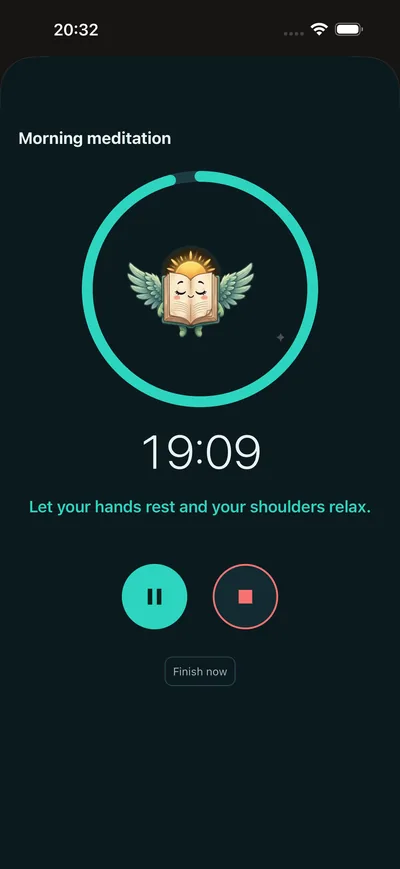
You don’t need an app to count ten breaths. Where a tool earns its keep is the middle stretch — the weeks where the novelty is gone and the habit isn’t solid yet. A timer removes clock-checking; occasional on-screen prompts (“back to the breath”) catch the long wanders; a soundtrack or deliberate silence marks the time as different from the rest of the day; and a session history turns an invisible practice into a visible one.
BrightLog’s guided sessions were built for exactly that middle stretch: pick a length, pick a soundtrack (or silence — the soundtracks ship inside the app and play fully offline), and gentle prompts surface at long intervals rather than chattering at you. Sessions can live inside a goal — the “guided meditation” task type — so your practice sits next to your moods and streaks. A daily nudge, Breathe, opens the same timer for a one-, three- or five-minute breathing break with no goal behind it — the middle-stretch prompt, delivered to your lock screen. And like everything else in the journal, the record of when you sat and for how long stays on your device. The in-app lesson says it plainly and we repeat it here: this is a practice for wellbeing — not a cure, and not a substitute for medical care.