Why preparation changes the hour
Preparation changes a therapy hour because it moves the remembering out of the room. Sessions are usually a week or more apart, and human recall compresses a week into its last two days and its single worst moment, so an unprepared hour opens with reconstruction — “how was the week?” — and the freshest, most vivid thing wins, whether or not it was the important thing. Ten minutes with a journal the evening before does that reconstruction outside the paid hour, so the session itself can start where the work is. Therapists know this; it’s why so many ask clients to keep diaries or mood records between sessions in the first place.
Preparation is not homework for its own sake, and nobody marks it. It is the reconstruction done in advance, on your own time and in your own words — so the hour is spent on the week rather than in search of it.
What to bring (three things)
Bring three things to a therapy session: the shape of the period since you last met, one or two specific episodes, and one question or intention. The shape is how the weeks trended, where the dip was and what it coincided with — the thing a mood log records and memory cannot. The episodes are moments concrete enough to work with: what happened, what you felt, what went through your mind. The intention is a single sentence about what you want from the hour. Together they take about ten minutes to gather from a journal, and they cover what most sessions spend their first stretch reconstructing. In more detail:
- The shape of the period — not a day-by-day account, the shape: how the weeks trended, where the dip was, what the dip coincided with. This is exactly what a mood log produces and memory cannot.
- One or two specific episodes, concrete enough to work with: what happened, what you felt (precisely — “humiliated” and “let down” are different sessions), what went through your mind. A filled-in thought record is this, ready-made.
- One question or intention for the session. Not an agenda that crowds out where the conversation needs to go — one sentence: “I want to understand why Sundays collapse.” Sessions with an intention wander less and land more.
The ten-minute prep routine
The ten-minute prep routine is four steps, done the evening before with your journal open: skim the entries since the last session (minutes one to four), pick the one or two episodes that most deserve the room’s attention (five to seven), find the precise word for what you felt in each (eight and nine), and write one sentence of intention for the session (minute ten). Skim, don’t relive; resist choosing only the most recent moment; and bring the intention written down, because intentions evaporate in waiting rooms. Ten minutes is the whole cost, and it is the difference between a session that starts with “how was the week?” and one that starts with the week.
Step by step:
- Minutes 1–4: skim the period. Read the entries since the last session — skim, don’t relive. Let the calendar view show you the shape.
- Minutes 5–7: pick the episodes. Choose the one or two moments that most deserve the room’s attention. Resist picking only the most recent.
- Minutes 8–9: name the feelings. For each episode, find the precise word. Precision here is half the session’s work done early.
- Minute 10: write the intention. One sentence. Bring it written down — intentions evaporate in waiting rooms.
Your first session: a simpler version
A first therapy session needs less preparation than people fear, because therapists are good at first sessions. What genuinely helps is a few lines on what brings you now (why this month and not last year), anything relevant about sleep, work and the support around you, and what you’d like to be different. With no journal history to skim yet, the simpler version is those three short notes. If you have even two weeks of mood entries, bring the shape of them — several clinicians’ intake forms ask for exactly this — and starting the record two weeks before a first appointment is one of the most useful things you can do while on a waiting list.
How BrightLog prepares a session with you
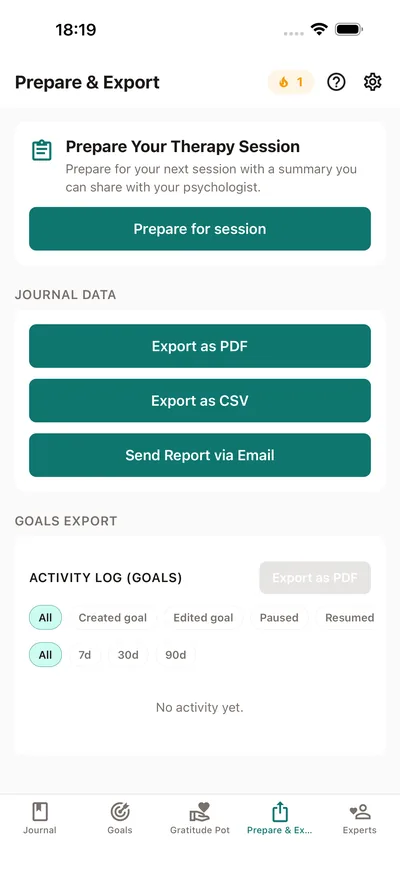
BrightLog prepares a session with you by doing the ten-minute routine above from your own entries. The Prepare & Export tab reads the entries in a range you choose — the last week, the last month, or any stretch up to 60 days — with the follow-up notes you added to them and your goals, and drafts the summary you’d otherwise assemble by hand, in seven parts: your mood and emotion trend, the states that kept coming up, triggers, thought patterns, what shifted since the period before, points to discuss, and Goals & habits — how often you did what you planned, what got in the way and what you wrote about it. No goals in that stretch? The last part becomes A goal that could help: one or two small goals to talk through with your therapist, each one tap from Create this goal. Ready to review, to share with your psychologist as a PDF or copied text if you choose to, and kept in a history so you can reopen it in the waiting room.
The card is called “Prepare Your Therapy Session” and sits at the top of the tab, with your past preparations listed beneath it. Your weekly goals summary leads straight to it: tap Use this in your therapy preparation, pick this week, the last two weeks or the last month, and the week you just looked back on is ready for the session. You stay the editor: it’s a draft to agree or argue with, and walking in with a draft you half-disagree with is still a better opening than reconstructing from memory.
It is deliberately cautious. It is written only when you ask, and the thought-patterns section carries the words that matter: These are AI-suggested patterns based on your entries and goals, not a clinical diagnosis. Discuss them with your psychologist. And your entries stay where they always were: on your device, where we never see them.
Which journaling app works for therapy?
The journaling app that works for therapy is the one whose notes you can turn into a dated, structured summary for the session — not a stream of entries to scroll through in the waiting room, but the shape of a chosen period, with the episodes and the feelings named, on a page you could hand over. Look for four things: a mood record that shows a pattern over weeks, not just today; a place to write a proper thought record when something knocks you sideways; a summary you can build from the dates you choose and share as a PDF; and a way to find a professional when the journal on its own is not enough.
BrightLog does all four. Its Prepare & Export tab builds the seven-part summary described above — mood and emotion trend, the states that kept coming up, triggers, thought patterns, what shifted, points to discuss, goals and habits — from any range you choose, up to 60 days, and exports it as a PDF or copies it as text, dated with the range it covers. A journal entry can carry a thought record — what happened, what went through your mind, the evidence for and against, and how it looks now — and the summary reads them. The mood log keeps the shape of the period that a therapist actually asks about, week by week. And the Experts tab lists psychologists, psychotherapists and counsellors near you, nearest first. The summary is written only when you ask, and carries its own caution on the page: These are AI-suggested patterns based on your entries and goals, not a clinical diagnosis. Discuss them with your psychologist. If you are starting from nothing, the guide to how to start journaling gets you to a fortnight of entries — enough for a first summary — before the appointment.
The honest boundaries
The honest boundaries are three, and we hold to them on the page and in the app. A journal supports therapy; it does not replace it and is not a substitute for it — if you’re deciding between the two, choose the human. A summary is a conversation starter, not an assessment — your therapist’s judgement outranks any pattern an AI suggests, including ours. And what you share is always your call: some people hand the summary over, some read one line from it, some just use the preparation to arrive clearer. All three are the tool working.