What it is (and isn’t)
Gratitude journaling is the practice of regularly writing down specific things that went well — usually one to three per sitting, usually in the evening. That’s the whole method. What it is not: forced cheerfulness, denying that a day was hard, or an obligation to feel thankful on command. On a genuinely bad day, “the tea was hot and nobody talked to me on the bus” is a perfectly legitimate entry — arguably the most useful kind, because it trains the skill the practice is actually about: noticing.
The working theory is attentional. Minds have a well-documented tilt toward threats and problems; a gratitude practice is a small daily counterweight — not to replace realistic seeing, but to stop the ledger recording only the debits.
The evidence, honestly stated
The honest summary of two decades of research: real, modest, positive effects — not a transformation. The classic studies (Emmons and McCullough’s counting-blessings experiments, and a long line since) tend to find that people assigned to gratitude writing report somewhat higher wellbeing, more optimism, and in several studies better sleep, compared with people writing about hassles or neutral events. Public health bodies — the UK’s National Health Service among them — list gratitude-style noticing among evidence-supported wellbeing habits.
Two caveats the sales pitches skip. First, effect sizes in the meta-analyses are small to moderate — a nudge, not a cure, and gratitude journaling is not a treatment for depression. Second, dose matters in a counter-intuitive way: at least one well-known finding suggests a few times a week can beat daily practice, because daily repetition slides into numb list-making. Treat “three things, some evenings, genuinely noticed” as the evidence-shaped dose — and treat anyone promising rewired brains in 21 days with suspicion.
Why people quit
- Repetition. By day twelve the list is “family, health, coffee” for the third time and the exercise feels dead. The fix is a specificity rule — see below.
- It becomes homework. A ten-item nightly quota is a chore generator. Small and honest beats long and dutiful, every time.
- It feels false on bad days. If the practice demands you feel grateful, a grim week breaks it. If it only asks you to find one thing that was better than it had to be, it survives — and bad-day entries turn out to be the ones worth rereading.
A practice that survives real weeks
- One to three things, most evenings — aim for four or five nights a week, not a perfect streak.
- The specificity rule: nothing generic. Not “my partner” — “she saved me the last dumpling.” Specific entries force fresh noticing, which is the active ingredient; generic ones are the practice dying politely.
- Add the because: “…because it meant I didn’t have to ask twice.” One clause of why it mattered is what several researchers suggest separates savouring from list-making.
- Let it be small. Weather, bread, a green light streak, a meeting that ended early. The practice is precisely about the size of things worth recording.
Making it stick inside a journal
Gratitude entries work best next to a journal rather than as a separate ritual, for two reasons. Attaching the habit to one you already have — you’re already writing your three sentences — is the cheapest way to keep it alive. And context makes rereading valuable: a good thing noticed on a day you logged as bad is oddly encouraging to find later. (Whether moods are worth scoring at all is its own question — here’s how mood tracking works.)
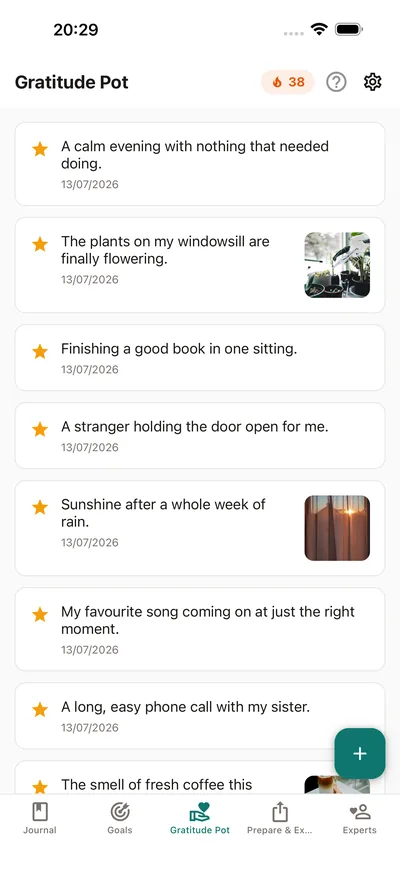
BrightLog gives the practice a home of its own, the Gratitude Pot: a tab beside the journal rather than a line inside it. Each entry — a sentence, a photo, a video — drops in with a small celebration, and once the pot holds ten, the app hands one back to you each day: a reminder of what you were grateful for, in your own words, on the mornings you need convincing that last month contained good things. An evening nudge, A good thing, offers a fresh note at most once a day — exactly the “some evenings, not a quota” dose the evidence favours — and every note counts for your daily streak. Gratitude notes are as private as the rest of your journal: they stay on your device, and a backup, only if you choose one, goes to your own iCloud or Google Drive. If you’re picking an app for a practice this personal, choose one whose privacy answers you’ve actually read; our guide to choosing a mood journal app lists the questions to ask, privacy first.