What a thought record is
A thought record is the workhorse tool of cognitive behavioural therapy. The idea behind it is simple and well-tested: it is rarely the situation itself that sinks your mood — it is the automatic thought about the situation, the instant interpretation that fires before you notice it. “He didn’t reply” is a fact. “He’s annoyed with me” is a thought — and it arrives dressed as a fact.
A thought record slows that moment down on paper. You write the situation, catch the automatic thought, name the feeling it produced, then examine the thought like a fair-minded outsider would — and write the more balanced version. The point is not forced positivity. The point is accuracy: automatic thoughts are first drafts, and first drafts written by a stressed brain are usually harsher than the evidence supports.
The steps, with a worked example
The classic format has seven moves. Worked through a real-shaped example:
- 1. Situation — just the facts, one line. “Sent my project update at 9 a.m. No reply by evening.”
- 2. Feeling, with intensity — name it and rate it out of 10. “Anxious 7/10, a bit ashamed 4/10.” The more precise the word, the better the whole exercise works — the feelings wheel is built for this step.
- 3. The automatic thought — what went through your mind, verbatim, however unreasonable it looks written down. “The update was bad. She thinks I’m not up to this.”
- 4. Evidence for — be honest, the exercise fails if you skip this. “She usually replies fast. The update was rushed.”
- 5. Evidence against — “She said yesterday this week was chaos. My last three updates got good feedback. No reply is not a review.”
- 6. The balanced thought — not the opposite, the fair second draft. “The update was rushed but probably fine; the silence is more likely her week than my work. I can ask tomorrow instead of guessing tonight.”
- 7. Re-rate the feeling — “Anxious 4/10.” A drop of two or three points is a normal, real result. Expecting zero is the wrong bar.
Common mistakes
- Writing the situation as an interpretation. “She ignored my message” is already a thought. The situation is “no reply”. Getting step 1 clean is half the work.
- Skipping the evidence-for column. If the record is a rigged trial, your own mind stops believing its verdicts. The tool works because it is fair.
- Turning the balanced thought into a pep talk. “Everything will be fine!” is not balanced, and the anxious part of you knows it. Write the sentence a wise, honest friend would actually say.
- Doing it only in your head. The writing is the mechanism. Thoughts loop; sentences on a page hold still long enough to be examined.
- Waiting for a calm moment. The best time is close to the trigger, while the automatic thought is still catchable verbatim. Even a two-line capture in the moment — situation and thought — can be finished properly later.
When it helps — and when it isn’t the tool
Thought records shine on repetitive, exaggerated interpretation: the catastrophising email re-read, the mind-reading (“they all noticed”), the harsh self-verdicts after ordinary mistakes. Used a few times a week, many people find the questioning starts to happen automatically, mid-thought — which is the actual goal; the paper version is training wheels. BrightLog’s in-app help names the 16 unhelpful thinking styles — mind reading, fortune telling, catastrophising and the rest — and ties each reframe to the record’s own columns, which is a quick way to learn the automatic version.
It is the wrong tool when the feeling is proportionate to a genuinely hard situation — grief, real loss, a real threat. A thought record cannot argue you out of a feeling the facts support, and it shouldn’t. And to be plain: this article and any app tool are self-help practice, not therapy. If low mood or anxiety is persistent or heavy, a qualified professional is the right next step — a stack of well-filled thought records is, incidentally, an excellent thing to bring to a first session. BrightLog’s therapy preparation reads them for you: its thought-patterns section lists the recurring themes it found, each with a possible thinking-style label, offered as AI-suggested patterns rather than a diagnosis.
Doing it on paper or in an app
Paper works — cognitive behavioural therapy ran on photocopied worksheets for decades. What paper is bad at is being there when the thought fires (few people carry the worksheet to the meeting), and connecting records to the rest of your emotional record over time.
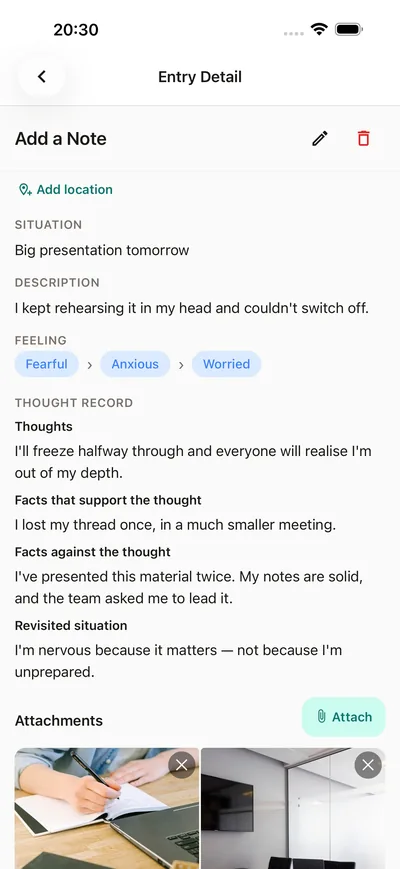
That is the case for keeping thought records inside a journal rather than a separate worksheet: the record sits next to the day’s mood and events, so a month later you can see not just that you were anxious, but what the thought was and how the second draft read. BrightLog builds the thought record into the entry itself. The entry already holds the situation and the feeling; the record adds four optional fields — the thought, the facts for it, the facts against it, and the situation revisited — so a situation and one thought is a complete entry and the evidence can be filled in later. Leave it half-written and it waits as a private draft. The record goes into your PDF and CSV exports, sits next to that day’s mood, and is as private as the rest of the journal: on your device, where we never see it. If you are choosing an app for this, our guide to choosing a mood journal app lists the privacy questions a page this personal deserves; and if you are starting from zero, start smaller than a thought record — three sentences a night first.